 Skip to content
OUPES Mega 3 Review 2026: Specs, Real World Use, Pros, Cons, and Who Should Buy It

- Credit: OUPES
If you have been comparing portable power stations for home backup or off-grid use, you have probably noticed a pattern. EcoFlow, Bluetti, and Jackery dominate the conversation, and for good reason. But a newer name keeps popping up in threads and comparison charts: OUPES. Their Mega 3 model, in particular, is drawing attention for offering a spec sheet that goes toe to toe with established flagships while carrying a noticeably lower price tag.
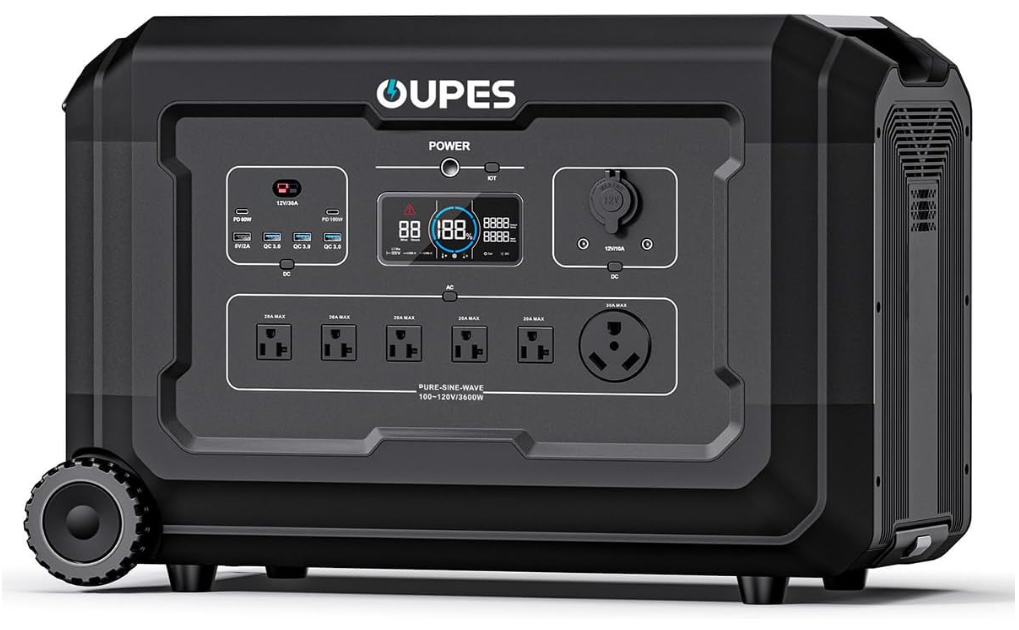
The OUPES Mega 3 is a 3,072Wh LiFePO4 power station built around a 3,600W continuous inverter with a 7,000W surge rating. On paper, that puts it in the same weight class as units costing several hundred dollars more. It also supports fast combined AC and solar charging, a built-in UPS backup function, and a modular battery system that can grow the setup well past 15kWh.
In this review, we will break down what the Mega 3 actually offers, how its specs compare to the competition, where it makes sense as a home backup or RV power source, and where a newer brand like OUPES still has ground to cover against companies with a longer track record. By the end, you should have a clear picture of whether the Mega 3 fits your power needs and your comfort level with a newer manufacturer.
Let’s get into it.
Pros
- 3,072Wh capacity, 3,600W output (7,000W surge)
- LiFePO4, 3,500+ cycles to 80%
- Fast charging: up to 3,900W combined
- UPS/EPS backup, sub-20ms switchover
- Expandable to 15.36kWh with B2 packs
- 16 output ports
- WiFi/Bluetooth app control
- 5 years warranty (6 with registration)
Cons
- Newer brand, less track record
- Not water-resistant
- Fewer accessories, smaller user base
- Expansion locked to OUPES B2 packs
OUPES Mega 3 Key Specifications
- Battery Capacity: 3,072 Wh (expandable up to 15.36 kWh with six B2 packs)
- Battery Chemistry: LiFePO4 (LFP)
- Cycle Life: 3,500+ cycles to 80% capacity
- Inverter Output (AC): 3,600 W continuous
- Surge Power : 7,000 W peak
- AC Outlets: 5× NEMA 5-20R (120V/20A) + 1× TT-30R (120V/30A)
- USB & DC Ports: 4× USB-A (QC 3.0), 2× USB-C (PD 100W each), 2× DC 5521 (12V/10A), 1× Anderson port (12V/30A), 1× car outlet (12V/10A)
- Solar Input: Up to 2,100 W (MPPT, 18–140V, 15A max)
- AC Charging: Up to 1,800 W (adjustable between 900W and 1,800W)
- Combined AC + Solar Input: Up to 3,900 W
- Recharge Speed: Roughly 1 hour for a full charge at maximum combined AC + solar input, per OUPES' published specs
- UPS/EPS Backup: Under 20 milliseconds switchover, up to 2,200 W
- Weight: Approximately 83.3 lb (37.8 kg)
- Dimensions: 25.2" × 11.9" × 17.2" (641.5 × 304.5 × 437.5 mm)
- App Control: Yes, WiFi (2.4GHz) + Bluetooth via the OUPES app
- Warranty: 5 years, extendable to 6 years with product registration
- Operating Temperature: 32–104°F (0–40°C)
- IP Rating: IP21 (not designed for outdoor rain exposure)
The OUPES Mega 3 positions itself as a mid to large capacity home backup and travel power station that competes directly with units like the EcoFlow Delta Pro 3 and Bluetti AC200L on raw output and charging speed, but at a price that undercuts both by a meaningful margin. Its 3,600W continuous inverter is enough to run power hungry appliances like induction cooktops, window air conditioners, and power tools, while the 3,072Wh base capacity gives it real staying power for overnight and multi-day use.
What sets the Mega 3 apart from many similarly priced competitors is its charging flexibility. With combined AC and solar input rated up to 3,900W, OUPES claims a full recharge in about an hour, a number that would be class-leading if it holds up consistently in everyday conditions rather than just lab testing. The built-in UPS function also gives it a genuine home backup use case, automatically switching over during an outage in under 20 milliseconds.
Key Highlights of the OUPES Mega 3
Aggressive Price to Spec Ratio
The core appeal of the Mega 3 is straightforward: 3,072Wh and 3,600W of continuous output at a price that typically sits below comparable units from Jackery, EcoFlow, and Bluetti. For buyers comparing raw numbers per dollar, it is one of the stronger options on the market right now.
Serious Expansion Potential
The Mega 3 can scale from its 3,072Wh base capacity up to 15.36kWh by adding up to six B2 battery packs. That is enough headroom to move from "big power bank" territory into genuine whole-home backup for essential circuits.
Long-Life LiFePO4 Battery
Rated for more than 3,500 cycles to 80% capacity, the battery chemistry is built for daily or near-daily cycling over roughly a decade, rather than the occasional use cycle you'd expect from cheaper lithium-ion units.
Fast, Flexible Charging
Between the 1,800W AC input, 2,100W solar input, and the ability to combine both for up to 3,900W total, the Mega 3 is designed to get back to full charge quickly, whether you're plugged into the wall, catching sun, or doing both at once.
UPS Style Backup Function
A sub-20ms automatic switchover means the Mega 3 can function as a genuine uninterruptible power supply for sensitive electronics, not just a manual backup you plug in after the power already goes out.
Well Rounded Port Selection
Sixteen total output ports, including dual USB-C PD 100W, an Anderson port, and a 30A TT-30R outlet, mean it is set up to handle RV connections, laptops, and small appliances simultaneously without constantly swapping cables.
Real World Use Cases of the OUPES Mega 3
Home Backup Power
When the grid drops, the Mega 3’s UPS function and 3,600W output are enough to keep a refrigerator, WiFi router, lighting, and a handful of essential devices running without interruption. Pair it with a B2 expansion battery or two, and it starts to look like a legitimate backup system for a multi day outage rather than a stopgap measure.
RV and Van Life
The combination of a 3,600W inverter and a 30A TT-30R outlet makes the Mega 3 a natural fit for RV setups that need to run an air conditioner, microwave, or induction cooktop without babysitting the battery level. Its solar input also makes it a reasonable option for boondockers who want to top off during the day.
Camping and Overlanding
For extended trips off the grid, the Mega 3’s capacity and fast solar recharge help keep coolers, CPAP machines, and camera gear powered through multi-day stretches without needing a wall outlet.
Remote Work and Off Grid Projects
The 3,600W continuous rating is enough to run small power tools, lighting rigs, or laptops and monitors for remote workers and small job sites where grid power is not an option.
Emergency Preparedness
Given the UPS backup mode, fast recharge, and expandable capacity, the Mega 3 is a reasonable centerpiece for a hurricane or storm preparedness kit, especially for households in outage-prone regions who want more than a few hours of runtime.
OUPES Mega 3 Performance and Charging
On paper, the Mega 3’s performance numbers are genuinely competitive. The 3,600W continuous, 7,000W surge inverter should be enough to start and run most single large appliances, including window air conditioners and induction cooktops, without tripping into overload. Because OUPES uses a pure sine wave inverter, sensitive electronics should run cleanly on it, the same way they would on a more established competitor’s unit.
Charging is where the Mega 3’s spec sheet stands out most. OUPES rates AC input at up to 1,800W (adjustable down to 900W if you want a gentler charge), solar input at up to 2,100W, and combined AC plus solar input at up to 3,900W. According to OUPES’ own published specs, that combined input can bring the unit from empty to full in about an hour under ideal conditions. That is an aggressive number, and as with any manufacturer supplied charging claim, real-world results will vary depending on panel setup, temperature, and grid conditions. If fast recharge speed is a priority for you, it is worth checking recent independent reviews and video breakdowns before assuming you will hit that one-hour mark in typical use.
The built-in UPS/EPS function is a meaningful differentiator for home backup shoppers. A sub 20 millisecond switchover means most electronics, including routers, computers, and smart home devices, should not even register the transition when grid power drops.
One area to note: the Mega 3’s expansion system is proprietary. It works only with OUPES’ own B2 battery packs, so buyers planning to scale up their capacity down the road should factor that into the total cost of ownership rather than assuming third-party batteries will work.
Is the OUPES Mega 3 Worth It?
For buyers focused purely on specs per dollar, the Mega 3 makes a strong case. A 3,072Wh LiFePO4 battery, 3,600W continuous output, and fast dual source charging typically come at a meaningfully higher price point from more established brands. The expansion path to 15.36kWh also means this is not necessarily a unit you outgrow quickly.
Where the calculation gets more nuanced is brand maturity. Jackery, EcoFlow, and Bluetti have years of field data, established repair networks, and a large enough user base that problems tend to surface (and get discussed) quickly. OUPES is newer, which does not mean the product is unreliable, but it does mean there is less accumulated real-world evidence about how these units perform after two, three, or five years of regular cycling. The 5 years warranty (extendable to 6 with registration) is reassuring on paper, but it is worth doing your own check on customer support responsiveness and how OUPES has handled warranty claims for early buyers before committing serious money.
The unit’s weight, at roughly 83 lbs, also puts it firmly in the “stays in one spot” category rather than something you will want to move often. And the IP21 rating means it needs to stay dry and sheltered, which rules out permanent outdoor placement.
For buyers who are comfortable being early adopters of a newer brand in exchange for stronger specs and a lower price, the Mega 3 is a legitimately compelling option. For buyers who prioritize a long-established name and a deep track record above spec sheet numbers, it is fair to want more time to see how OUPES performs over the coming years.
Who Should Buy the OUPES Mega 3
Budget Conscious Buyers Who Still Want Strong Specs
If you want capacity and output numbers that rival pricier flagship units without paying flagship pricing, the Mega 3 is built for exactly that trade-off.
Home Backup Shoppers
The UPS function, solid continuous output, and expandable battery system make it a reasonable core for a home backup plan, particularly for households in regions with frequent outages.
RVers and Road Trippers
The 30A outlet, strong inverter output, and fast charging suit RV setups that need to run larger appliances without constant power anxiety.
Buyers Comfortable With Newer Brands
If you have bought from newer direct-to-consumer electronics brands before and are comfortable with a shorter track record in exchange for better specs and pricing, the Mega 3’s value proposition is easy to see.
Emergency Preparedness Shoppers
Fast recharge, UPS switchover, and the option to scale capacity with B2 packs make it a solid pick for households building a storm or outage preparedness kit that needs to last more than a few hours.
Final Verdict: Is the OUPES Mega 3 Worth It?
The OUPES Mega 3 is one of the more interesting value plays in the portable power station market right now. A 3,072Wh LiFePO4 battery, 3,600W continuous output, fast dual-source charging, and a genuine UPS backup function are a strong combination, especially at a price point that undercuts many established competitors offering similar numbers.
The trade off is brand maturity. OUPES simply has not been around as long as Jackery, EcoFlow, or Bluetti, so there is less long-term field data to lean on, and the accessory and third party support ecosystem is thinner. That is not a dealbreaker for most buyers, but it is a real factor worth weighing, particularly for anyone planning to rely on this unit for critical home backup over many years.
If you are comfortable being an earlier adopter of a newer brand in exchange for premium-tier specs at a more accessible price, the Mega 3 is worth serious consideration. If an established, long tenured brand with a deep support history matters more to you than the numbers on the spec sheet, it is reasonable to wait and watch how OUPES’ track record develops, or to choose a more established competitor instead.
FAQ
The Mega 3 uses a 3,072Wh LiFePO4 (LFP) battery, rated for more than 3,500 cycles to 80% of original capacity.
It delivers 3,600W of continuous AC output with a 7,000W surge rating, which is enough to run most household appliances, including induction cooktops and window air conditioners.
According to OUPES’ published specs, the unit supports up to 1,800W of AC input, up to 2,100W of solar input, and up to 3,900W combined, which the company states can bring it from empty to full in about an hour under ideal conditions.
Yes. It can scale from its 3,072Wh base capacity up to 15.36kWh using up to six OUPES B2 battery packs. It is not compatible with third-party expansion batteries.
Yes, it includes a UPS/EPS function with a switchover time of under 20 milliseconds and up to 2,200W of backup power.
It has 16 total output ports, including five NEMA 5-20R AC outlets, one TT-30R 30A outlet, four USB-A ports, two USB-C PD 100W ports, two DC 5521 ports, one Anderson port, and one 12V car outlet.
The base unit weighs approximately 83.3 lb (37.8 kg). It is movable but not lightweight, and it is best suited for a semi-permanent setup rather than frequent carrying.
OUPES offers a 5-year warranty, extendable to 6 years with free product registration.
No. It carries an IP21 rating, meaning it should be kept dry and sheltered from rain and outdoor exposure.
Looking for alternatives? We reviewed the 7 Best Solar Generators for Off grid living to help you choose the right one for your needs.
Share


