 Skip to content
Jackery Explorer 300 Review 2026: Compact Power Station Under $500 Tested Against Real Needs

- Credit: JACKERY
If you’ve been scrolling through solar generator reviews feeling overwhelmed by 3,000W inverters and 12kWh expansion systems, the Jackery Explorer 300 is a welcome reset. Not everyone needs a home backup system. Sometimes you just need something small, dependable, and cheap enough that you won’t think twice about tossing it in the trunk.
At 293Wh, this isn’t a power station built to run your refrigerator through a blackout or keep your RV air conditioner humming. It’s built for a narrower job: keeping your phone, laptop, camera gear, router, and small devices charged when you’re off the grid for a day, a weekend, or an unexpected outage. And for that job, it does exactly what it promises.
In this Jackery Explorer 300 review, we’ll walk through the specs, real world performance, charging speed, pros and cons, and most importantly who should actually buy this thing (and who should spend their money elsewhere).
Let’s get into it.
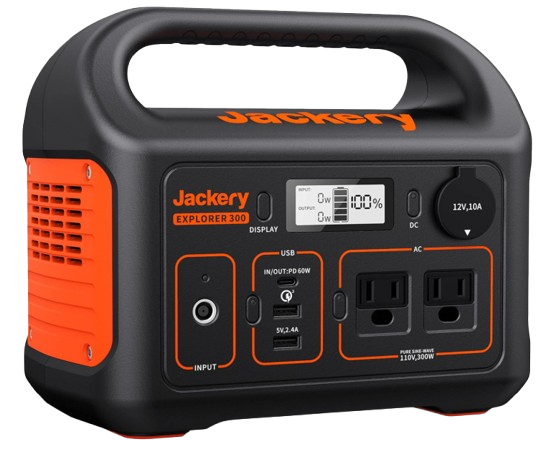
Pros
- Very lightweight about 7 lbs, true grab-and-go
- Affordable, typically under $300–$500
- Fast recharge 0–80% in about 2 hours (wall + USB-C)
- Pure sine wave inverter with built in BMS protection
- Quiet operation, around 36.4 dB
- Backed by Jackery's long track record and 2+1 year warranty
Cons
- Limited 300W output not built for large appliances
- Small 293Wh capacity means short runtimes
- No expandable battery option
- Standard lithium ion, not LiFePO4 (Explorer 300 Plus has LiFePO4)
- Only ~800 charge cycles lower than Jackery's LiFePO4 models
Jackery Explorer 300 Key Specifications
- Battery Capacity: 293 Wh
- Battery Chemistry: Lithium-ion (standard Explorer 300 model)
- Inverter Output (AC): 300 W continuous, 500 W surge
- Inverter Type: Pure sine wave
- AC Ports: 2× AC outlets
- DC & USB Ports: 60W USB-C PD, USB-A with Quick Charge 3.0, USB-A standard, 12V car port
- Solar Input: Up to 100 W (via SolarSaga panel)
- Recharge Options: AC wall, USB-C PD, solar (MPPT), car
- Recharge Speed: ~2–2.5 hrs wall + USB-C combined (0–80% in ~2 hrs); ~3.5–5 hrs solar (0–80%) with a 100W panel; ~5 hrs car
- Cycle Life: Roughly 800 cycles to 80% capacity
- Weight: 7.1 lb (3.2 kg)
- Noise Level: ~36.4 dB
- Simultaneous Devices: Powers up to 6 devices at once
- Warranty: 2 years + 1 year extension (auto applied on official site purchases)
Key Highlights of the Jackery Explorer 300
Genuinely Portable
At just over 7 lbs, this is one of the few power stations you can carry one handed without thinking about it. It slips into a backpack, a car door pocket, or a daypack without adding meaningful bulk a real difference from the 60+ lbs flagship units built for home backup.
Fast, Flexible Charging
You don't need to plan a recharge window around this unit. Jackery states it charges from empty to roughly 80% in about 2 hours when combining a 90W wall charger with a 60W USB-C PD charger, and Jackery's own testing shows full solar recharge in about 3.5 to 5 hours with a 100W panel, depending on sun conditions.
Built In Safety Features
The unit includes a Battery Management System (BMS) with temperature sensing, which helps protect connected devices from voltage spikes and protects the battery itself from extreme heat or cold.
Quiet, Unobtrusive Operation
At roughly 36.4 dB, the Explorer 300 runs quietly enough for a tent, a bedroom, or a small office during a power blip you're not going to notice it working in the background.
Versatile Port Selection for Multiple Devices
Between the two AC outlets, 60W USB-C PD port, USB-A with Quick Charge 3.0, standard USB-A, and 12V car port, the Explorer 300 can power up to six devices simultaneously useful for shared campsites or families juggling several gadgets at once.
Straightforward, No Learning Curve Design
There's no app to configure, no expansion packs to plan around, and no complicated settings menu. Plug in, press the button, and it works. For first-time buyers, that simplicity is part of the appeal.
RealWorld Use Cases
Weekend Camping Trips
This is arguably where the Explorer 300 makes the most sense. It’ll keep a phone topped off for days, run a string of LED lights all night, keep a Bluetooth speaker going, and still have juice left for a camera battery or two.
Van Life and Car Camping
For minimalist van setups where space and weight matter more than raw power, the Explorer 300 handles the basics: laptop charging, router power for working remotely, and lighting without eating into your storage space or your payload.
Basic Emergency Backup
It won’t run your fridge, but it will keep your phone charged, a small fan running, a radio on, and a light source active during a short outage. For apartment dwellers or anyone without space for a full-size backup system, that’s often enough.
Photography and Drone Trips
Camera batteries, drone batteries, and laptop charging for photo backups are well within its comfort zone. It’s light enough to carry alongside camera gear without becoming its own burden.
Everyday Device Charging On the Go
Tailgates, picnics, remote workdays at the park anywhere you’d normally rely on a power bank but need something with more headroom, this fills the gap nicely.
Performance and Charging
The 300W continuous / 500W surge inverter is enough for small electronics, box fans, mini coolers, and similar low-draw devices, but it’s not designed for anything resembling a full-size appliance. Jackery’s own running-time estimates give a sense of scale: a 5W light can run for roughly 24 hours, a phone can get around 16 charges, and a 55W electric blanket runs for about 4 hours on a full charge.
Charging is genuinely one of this unit’s strengths relative to its size. Combining the wall charger and USB-C PD input gets you to a high state of charge in a couple of hours rather than the half-day-plus wait you’d get from many budget competitors. Solar charging via a 100W panel is slower, in the 3.5 to 5 hours range for 0–80%, which is reasonable for a portable panel setup but obviously dependent on sun conditions and panel angle.
One thing worth flagging clearly: this base Explorer 300 model uses standard lithium ion chemistry, not LiFePO4. That means a shorter cycle life roughly 800 cycles to 80% capacity compared to the 3,000+ or 4,000+ cycle ratings you see on Jackery’s LiFePO4 based units. If you plan to use this daily for years, or you simply want the longer lasting chemistry, the Explorer 300 Plus is worth comparing before you buy, even though it costs more.
Is the Jackery Explorer 300 Worth It?
For its intended use case, yes. This isn’t a home backup solution, and it was never marketed as one so judging it against a 2,000Wh unit misses the point. Judged as a compact, affordable entry point into portable power, it holds up well.
The combination of low weight, quick charging, and a legitimate track record from an established brand makes it an easy recommendation for people who just need reliable small-device power without spending $500+. Where it falls short is scalability: there’s no expansion pack option, so if your power needs grow, you’re not upgrading this unit you’re replacing it.
Who Should Buy the Jackery Explorer 300
First Time Solar Generator Buyers
If you’re testing the waters with portable power and don’t want to commit to a large investment, this is a low risk way to get familiar with how solar charging and power stations work.
Campers and Weekend Adventurers
For lights, phones, speakers, and small camp electronics, this covers the essentials without adding real weight to your pack or vehicle.
Van Lifers and Minimalist Travelers
Its small footprint and light weight make it a sensible fit for space constrained setups where a bigger unit simply wouldn’t make sense.
Photographers and Content Creators on the Move
Camera and drone batteries, laptops for editing, and phone charging are all well within its capability, and its portability matches the on the go nature of that work.
Budget Conscious Emergency Preppers
For basic outage coverage phone, light, small fan, radio this is an affordable way to add a layer of preparedness without a major purchase.
Final Verdict: Is the Jackery Explorer 300 Worth Buying?
The Jackery Explorer 300 isn’t trying to be everything and that’s exactly why it works. It’s a lightweight, no fuss power station built for people who need reliable charging for small devices, not a backup power system for a house or RV.
At around $259 direct from Jackery (with Amazon pricing sometimes varying), it delivers fast charging, quiet operation, solid safety features, and the reputation of a brand that’s been in this space for years. The trade offs limited output, no expansion, and standard lithium-ion chemistry are reasonable given the price point and intended use.
If you fall into the camping, van life, photography, or basic backup category, this is a smart, low risk purchase. If you need to power appliances or plan to scale up your system down the road, save up for one of Jackery’s larger expandable units instead.
FAQ
It has a 293Wh capacity using standard lithium-ion battery chemistry. The Explorer 300 Plus variant uses LiFePO4 instead, if longer cycle life is a priority.
Jackery rates the battery for roughly 800 cycles before it drops to 80% of original capacity.
The inverter delivers 300W continuous output with a 500W surge for brief power spikes.
Combining a 90W wall charger with a 60W USB-C PD charger gets it to around 80% in roughly 2 hours. Solar charging with a 100W panel typically takes 3.5 to 5 hours for the same range, and car charging takes around 5 hours.
It can run low-draw mini-fridges or CPAP machines for a limited time, but total runtime will be short given the 293Wh capacity — a few hours at most depending on the device’s wattage.
No. The Explorer 300 does not support battery expansion packs. If you expect your power needs to grow, an expandable series model is a better long-term choice.
Jackery states it can power up to six devices simultaneously across its AC, USB-C, USB-A, and car ports.
No, it’s rated at around 36.4 dB, which is quiet enough for indoor or nighttime use.
The Explorer 300, an AC charging cable, a car charger cable, and a user manual. Solar panels are sold separately.
A 2-year warranty plus a 1-year extension, which is automatically applied when purchased through Jackery’s official website.
Looking for alternatives? We reviewed the 8 Best Solar Generators to help you choose the right one for your needs.
Share


