 Skip to content
Goal Zero Yeti 6000X Review 2026: Massive Capacity

- Credit: Goal Zero
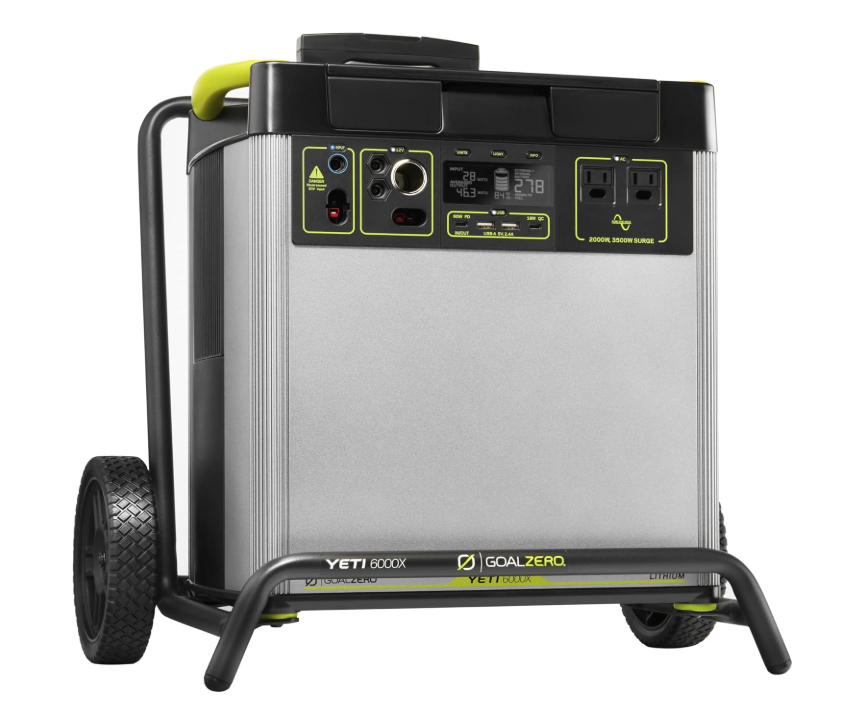
If your main worry isn’t a quick overnight outage but a multi day power failure the kind that hits after a hurricane or an ice storm the Goal Zero Yeti 6000X is built with that scenario in mind. At 6,071Wh, it has the largest single unit battery capacity of any power station in this comparison, enough to run a full size refrigerator for well over 100 hours on its own.
But before recommending it, there’s something buyers need to know upfront: the Yeti 6000X uses a different battery chemistry than most of its modern competitors, and that difference has real long term implications. This review walks through what the 6000X does well, where it falls short, and who should actually consider it over a LiFePO4 based alternative.
Pros
- 6,071Wh capacity for multi day backup
- 2,000W inverter, 3,500W surge
- Compatible with Home Integration Kit
- Silent, emission free operation
- Seven port types, incl. 60W USB-C PD
Cons
- NMC battery only ~500 cycles, well below LFP competitors
- Heavy at 106 lbs
- Just 2 years warranty
- Slow AC recharge (~12 hours)
- Goal Zero's newer models already use LFP
Goal Zero Yeti 6000X Key Specifications
- Battery Capacity: 6,071 Wh
- Battery Chemistry: Li-ion NMC
- Cycle Life: ~500 cycles to 80% capacity
- Continuous Output: 2,000W
- Surge Output: 3,500W
- AC Recharge Time: ~12 hours (0–100%, via included 600W charger)
- Solar Input: Up to 600W actual max
- Weight: 106 lbs (48.1 kg)
- Dimensions: 15.3 × 10.1 × 17 in
- Warranty: 2 years
- Home Integration: Compatible with Yeti Home Integration Kit (sold separately)
- Ports: 2× 120V AC (2,000W/3,500W surge), 2× USB-A, 1× USB-C, 1× USB-C PD (60W), 2× 6mm 12V, 1× 12V car port, 2× high-power 12V ports
Key Highlights of the Goal Zero Yeti 6000X
Largest Single Unit Capacity in Its Class
At 6,071Wh, the Yeti 6000X holds more energy in one unit than most competing power stations, making it a strong option for anyone who wants maximum runtime without chaining multiple batteries together.
2,000W Inverter with 3,500W Surge
The inverter is rated to handle demanding loads like full size refrigerators, medical devices, and general household appliances, with enough surge capacity to manage motor startup spikes.
A Battery Chemistry Worth Understanding
Unlike most modern competitors that use LiFePO4, the Yeti 6000X runs on Li-ion NMC chemistry, rated for roughly 500 cycles to 80% capacity. It's a real tradeoff for the large capacity great for occasional, infrequent use, less ideal for daily cycling.
Seven Versatile Port Types
Between dual 120V AC outlets, USB-A, USB-C, a 60W USB-C PD port, 12V outputs, and a car port, the 6000X can power a wide mix of devices at once without needing extra adapters.
Direct Home Circuit Integration
Paired with the separately sold Yeti Home Integration Kit, the 6000X can connect to up to four essential home circuits, giving it a more seamless backup experience than running extension cords room to room.
Silent, Emission Free Backup
As a battery-based system, it runs with no fumes, no fuel, and no noise a meaningful advantage over a gas generator for indoor adjacent or nighttime use during an outage.
Real World Use Cases
Rural and Storm Prone Areas Facing Multi Day Outages
This is the scenario the Yeti 6000X is genuinely built for. If you live somewhere that regularly loses power for 2–5 days at a stretch hurricane country, areas prone to ice storms, or rural regions with slow utility response the sheer capacity here means you’re less likely to run out before the grid comes back.
Home Circuit Backup
Paired with the Yeti Home Integration Kit (sold separately), the 6000X can connect directly to up to four essential home circuits, covering things like refrigerators, lighting, medical devices, and internet equipment without needing to run extension cords room to room.
Occasional Use Emergency Power
Households that only expect to cycle the battery a few times a year rather than using it as a daily solar charged home battery are well positioned to get long service life out of this unit despite the lower cycle rating.
RVs, Trailers, and Work Sites
The large capacity and multiple port types make it workable for extended off grid stints in an RV or at a job site, though its 106 lb weight makes it a fixed installation rather than something you move often.
Performance & Charging
The inverter performance itself is solid Goal Zero rates the 6000X to handle full size refrigerators, medical devices, and general household appliances without issue, and the pure sine wave output is standard for sensitive electronics.
Where the 6000X falls behind more recent releases is charging speed. A full AC recharge takes about 12 hours using the included 600W charger noticeably slower than newer power stations that recharge to 80% in under an hour. Solar charging is similarly modest: Goal Zero’s own numbers show that even with 800W of rated solar panels, a full recharge takes 11 to 18 hours of sunlight, and with smaller panel setups, that stretches to multiple days. If fast recharging matters to you say, you need to top off between storms this is a real limitation to weigh against the large capacity.
Is the Goal Zero Yeti 6000X Worth It?
For the right use case, yes but it’s a narrower use case than the raw capacity numbers might suggest. If your priority is having the largest possible battery on hand for occasional, infrequent multi day outages, and you’re comfortable with slower recharging and a shorter cycle life in exchange for that capacity, the 6000X delivers genuine value.
Where it’s harder to recommend is for anyone planning frequent or daily use running it as a regular solar charged home battery, cycling it often for van life, or using it as a primary power source rather than an occasional backup. In those scenarios, the roughly 500 cycle NMC battery will show its age faster than an LFP alternative would, and the slower charging becomes a bigger daily inconvenience.
Who Should Buy the Yeti 6000X?
Buyers prioritizing maximum single unit capacity
If you want the largest battery you can get in one box without chaining multiple units together, the 6,071Wh capacity here is hard to beat.
Households facing occasional, multi day outages
Rural areas or storm prone regions where power loss happens a few times a year, not daily, get the most value from this unit’s capacity to cycle life tradeoff.
Buyers who don't need fast recharging
If topping off quickly between charges isn’t a priority, the 12 hours AC recharge time is a manageable tradeoff for the capacity gained.
Homeowners wanting direct circuit backup
Paired with the Home Integration Kit, the 6000X can wire directly into essential circuits like the fridge, lighting, and internet equipment, rather than relying on extension cords during an outage.
Buyers who value quiet, fume free power over portability
If the unit will mostly sit in a garage, basement, or utility closet rather than travel with you, the 106 lbs weight is a non issue, and the silent operation is a real upgrade over a gas generator.
Final Verdict
The Goal Zero Yeti 6000X is a capacity first power station, and it delivers exactly that: the largest single unit battery in this comparison, enough to run a refrigerator for days rather than hours. For buyers facing genuine multi day outage risk who cycle their battery only occasionally, that tradeoff makes sense, and the unit’s port selection and home integration compatibility round out a legitimate backup solution.
Where it asks for real compromise is battery chemistry and charge speed. The roughly 500 cycle NMC battery and 12 hours AC recharge time are notable step downs from the LFP based competitors dominating this category today, and Goal Zero’s own move to LFP chemistry in its newer Yeti PRO line is a signal worth paying attention to.
Verdict: If maximum single unit capacity for occasional, infrequent outages is your top priority, and you’re comfortable with the shorter battery lifespan tradeoff, the Yeti 6000X earns its place. If you’re planning regular or daily use, an LFP based alternative like the EcoFlow DELTA Pro or Jackery Explorer 2000 Plus will hold up considerably longer over time.
FAQ
The Yeti 6000X has a 6,071Wh battery, the largest single unit capacity among comparable portable power stations in its category.
It uses Li-ion NMC chemistry, rated for approximately 500 cycles to 80% capacity notably lower than the LiFePO4 (LFP) chemistry used in most modern competing power stations, which typically rate for 2,000 to 6,500+ cycles.
It delivers 2,000W of continuous output with a 3,500W surge rating, enough to run full size refrigerators and most standard household appliances.
Via the included 600W AC wall charger, a full 0 to 100% recharge takes about 12 hours. Solar recharge times vary by panel wattage Goal Zero lists 11–18 hours with 800W of rated panels, up to 35–70 hours with a single 200W panel.
Yes, with the separately sold Yeti Home Integration Kit, it can back up to four essential home circuits directly.
It weighs 106 lbs, making it a stationary or semi permanent backup unit rather than something you’d carry frequently.
It comes with a 2 years warranty, shorter than the 3 to 5 years warranties common among LFP based competitors.
It’s better suited to occasional, infrequent use. Its roughly 500 cycle NMC battery will show capacity loss faster under daily cycling than LFP based alternatives designed for regular solar charging routines.
It has two 120V AC outlets (2,000W/3,500W surge), two USB A ports, one USB C port, one 60W USB C PD port, two 6mm 12V ports, a 12V car port, and two high power 12V ports seven port types in total.
Looking for alternatives? We reviewed the 7 Best Solar Generators for Home Backup and 10 best portable solar generators in 2026 to help you choose the right one for your needs.
Share


